Seagate 40TB HDD: HAMR Technology, Mozaic 4+ with 4TB/platter
The data storage industry is at a decisive moment. Although SSDs dominate high-performance applications, mechanical hard disk drives (HDDs) continue to evolve to meet massive storage demands. The announcement of the Seagate 40TB HDD, based on the Mosaic 4+ platform, proves that the HDD still has a strategic role in data centers, cloud computing, and big data.
This article presents an in-depth technical analysis of the Seagate 40TB HDD, explaining how HAMR (Heat-Assisted Magnetic Recording) technology works, its physical characteristics, practical applications, and, most importantly, the direct impacts on data recovery in very high-density HDDs.
What is the Seagate Mosaic 4+ 40TB HDD?
The Seagate Mosaic 4+ 40TB hard drive is an enterprise-grade hard disk drive, still in the qualification phase with hyperscale data center clients. The product is not available to end consumers and there are no plans for retail sales.
According to Seagate, large-scale production is planned for the first half of 2026, with engineering samples already in operation in controlled environments.
Target audience for the 40TB HDD
- Data center operators
- Cloud storage providers
- Big data and artificial intelligence companies
- Large-scale archiving environments
Mozaic 4+ technology and HAMR recording: how does it work?
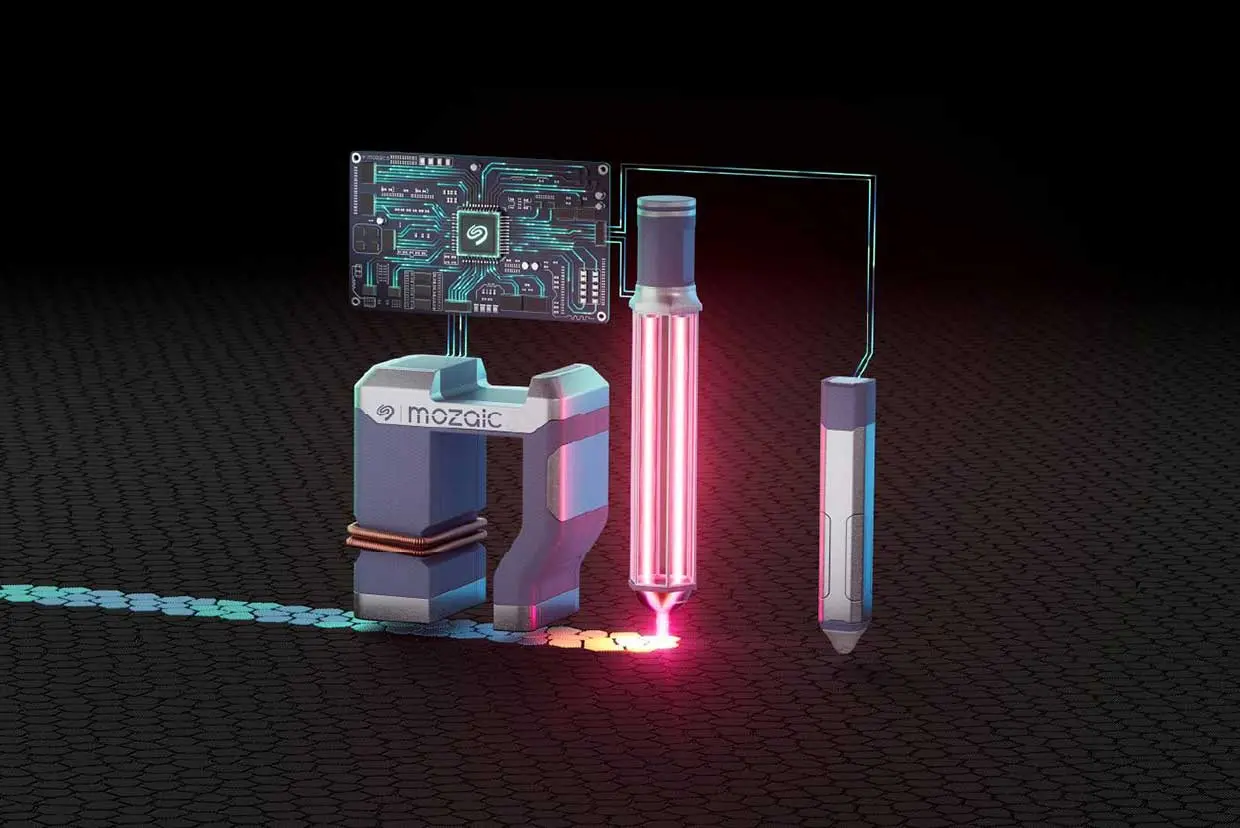
The major differentiator of the Seagate 40TB HDD is the HAMR – Heat-Assisted Magnetic Recording technology, implemented in the Mosaic 4+ platform.
What is HAMR?
Heat-assisted magnetic recording allows for a drastic increase in data density per platter, overcoming the physical limitations of traditional technologies such as PMR and SMR.
The process works as follows:
- A microscopic laser embedded in the read/write head heats a specific point on the platter.
- The heating temporarily reduces the coercivity of the magnetic material.
- Smaller, denser bits are recorded with thermal stability.
- Cooling occurs almost instantly.
This extremely localized thermal control allows for more precise, reliable, and durable recording, even at densities far superior to previous generations of HDDs.
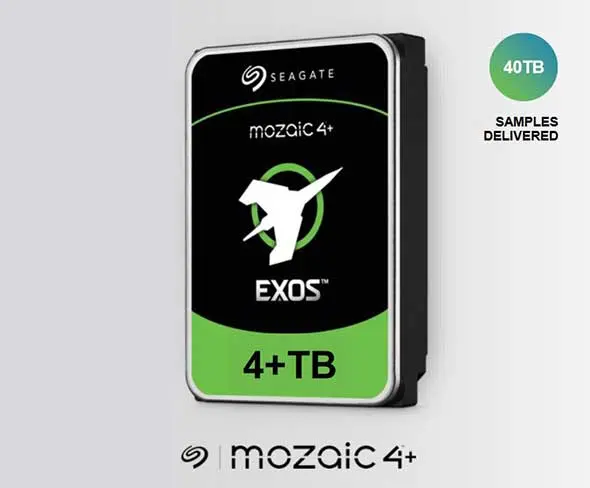
Seagate 40TB Mosaic 4+ HDD - Image Credit: Seagate
The revolutionary physical architecture of the Seagate Mozaic 4+ 40TB
From a structural point of view, the Mozaic 4+ 40TB hard drive boasts impressive numbers while maintaining the standard 3.5-inch form factor:
- 10 high-density platters — a high number for the 3.5" form factor, but optimized for maximum reliability and thermal/mechanical control
- 4TB per platter — a gigantic leap in areal density (approximately 30–33% more than the ~3–3.6TB/platter of previous Mozaic 3+ generations)
- Record-breaking areal density — made possible by HAMR (Heat-Assisted Magnetic Recording) technology in its most advanced version
- Next-generation magnetic materials — such as super-lattice iron-platinum structures and read/write heads with integrated plasmonic laser
It is the result of more than a decade of development in HAMR + extreme precision mechanical engineering, nanometer-scale localized heat control, and more precise servo tracking. much thinner.
Benefits of this architecture:
- Higher capacity per physical unit
- Reduced energy consumption per terabyte
- Space Optimization in Data Center Racks
- Lower Total Cost of Ownership (TCO)
In short: what previously required multiple drives (or larger enclosures) now fits into a single standard slot — a huge saving in space, energy, and cost per TB in hyperscale and AI data centers.
Laser-on-wafer: Seagate Mosaic 4+ Technology
In previous generations of Seagate's HAMR platform, such as Mosaic 3+, the architecture used a laser source external to the slider (laser-on-slider). In this model, the laser emitted optical energy that was then coupled to the HAMR transducer via waveguides, locally heating the magnetic medium during the etching process. While effective, this approach imposed limitations in terms of optical efficiency, thermal control, and assembly complexity.
With Mosaic 4+, Seagate introduces a significant architectural change by adopting a laser-on-wafer design (Wafer-Laser Integration), in which the laser is vertically integrated during the wafer manufacturing process of the slider. This integration allows the laser source to be a structural part of the slider itself, eliminating the need for external optical coupling and reducing losses along the light path. The result is a more compact, efficient system aligned with advanced large-scale manufacturing processes.
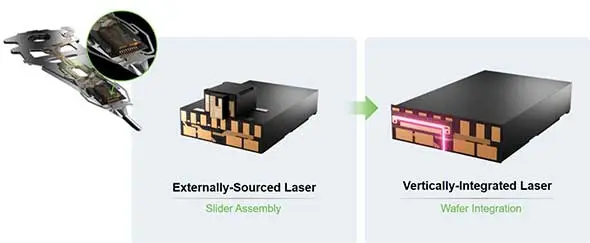
External Laser and Laser integrated into the wafer - Image Credit: Seagate
This new approach enables what can be described as a true laser-on-wafer, highlighting not only the manufacturing method but also the physical and functional location of the laser within the HAMR assembly. By combining vertical integration, improved thermal control, and greater optical stability, Mozaic 4+ establishes a more robust technological foundation for scaling the areal density and reliability of the next generations of HAMR hard drives.
Performance and applications of the 40TB HDD
It is important to note that the 40TB HDD is not designed for low latency, like an NVMe SSD. Its focus is on throughput, reliability, and massive capacity.
Key applications include data lakes, corporate backups, long-term archiving, streaming platforms, AI and machine learning environments based on large volumes of data.
In sequential workloads, these drives offer excellent performance per watt, a critical factor for large operations.
Reliability and durability in HAMR HDDs
Despite the technological complexity, Seagate claims that the Mosaic 4+ platform maintains high reliability standards, equivalent to or exceeding traditional enterprise HDDs.
However, the adoption of HAMR introduces new critical factors:
- Read heads with optical components
- Highly adaptive firmware
- Thermal control at the nanometer level
- Extremely tight mechanical tolerances
These factors directly impact the data recovery process in HAMR HDDs.
Data recovery in 40TB HDDs: new technical challenges
The arrival of HDDs with 40TB capacity completely changes the landscape of data recovery in hard drives.
Key Technical Challenges
- Extremely sensitive HAMR heads - The read/write heads are not easily interchangeable, requiring precise alignment and calibration.
- Advanced and proprietary firmware - Much of the write, read, and temperature control is embedded in the firmware, making intervention difficult.
- Extreme data density - Small misalignments or scratches on the media can result in significant data loss.
- Greater complexity in physical failures - Mechanical, electrical, or thermal damage requires advanced cleanroom procedures.
RAID, data centers, and the risk of data loss
Although these drives are mostly used in enterprise RAIDs, this does not eliminate risks. On the contrary:
- RAID rebuilds with 40TB drives are lengthy
- Rebuild time increases the likelihood of additional failures
- RAID does not replace backup
Information security and hard drive lifecycle
40TB drives store massive volumes of sensitive data, raising important concerns:
- Secure data sanitization
- Forensic recovery
- Post-failure analysis
- Compliance with international standards
Even after critical failures, these drives may still contain recoverable data, making proper disposal or reuse essential.
The future of HDDs: 44TB, 50TB and 100TB
Seagate's roadmap indicates continuous advancements:
- 44TB by 2027
- 50TB in 2028
- 100TB around 2030
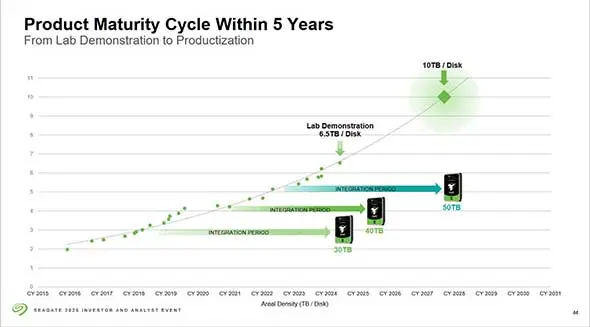
Mozaic Technology Roadmap - Image Credit: Seagate
All based on the evolution of HAMR technology. For data recovery companies, this means constant investment in knowledge, tools and infrastructure.
Conclusion: A new benchmark for data storage and recovery
The Seagate Mosaic 4+ 40TB hard drive represents a milestone in the history of magnetic storage. It redefines the limits of HDDs and imposes new technical challenges for hard drive data recovery professionals.
As these drives enter production starting in 2026, the ability to handle failures in very high-density environments will become a critical differentiator. On a 40TB hard drive, every technical decision can mean the loss or recovery of immense volumes of information.