ePMR Technology in Hard Drives: An Evolution of PMR
In recent years, data storage has evolved rapidly. This brings more efficient and secure solutions. One new development is ePMR (Enhanced Perpendicular Magnetic Recording) technology. It is used in hard disk drives (HDDs) and was developed by Western Digital (WD).
In this article, we will explain what ePMR is. We will see how it expands the limits of traditional PMR. We will also discuss its advantages, uses, and the impact on the future of data.
What is ePMR?
ePMR is an improvement on Perpendicular Magnetic Recording (PMR). PMR changed how data is recorded on HDDs. It allows more data in less space than the old recording. ePMR goes further. It uses vertical recording. This stores more bits in smaller areas. The result? Disks with more capacity.
This technology helps meet the growing demand for storage. Think of photos, videos, and large files. With ePMR, HDDs become more powerful without increasing in size.
How Does ePMR Technology Work?
ePMR uses a simple but advanced principle. It adds an extra electrical current to the recording head. This is located near the surface of the disk. The goal is to reduce "jitter." Jitter is noise that makes recordings inconsistent.
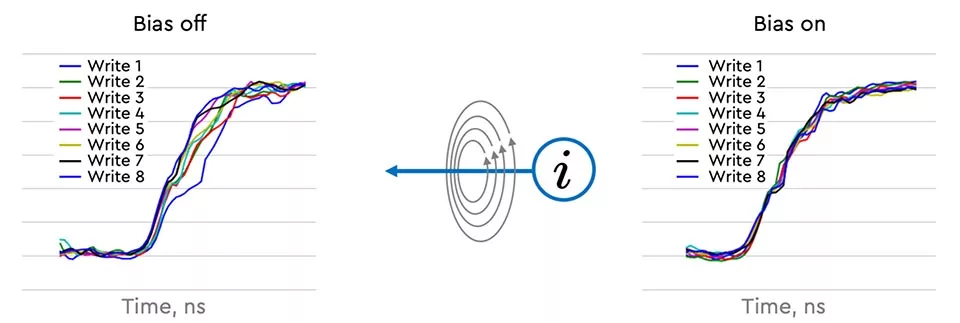
Jitter with and without ePMR - Image Credit: Disclosure
WD found a solution. They add an active current during recording. This creates an extra magnetic field. It reduces jitter in the currents. Thus, recording control improves.
The recording head has two assist elements. The first is coupled to the second. The first is called FEePMR (Field Effect ePMR). It has inductance. The second has resistance.
The FEePMR provides assistance to the main recording field. This field comes from the main pole, driven by a coil.
There are two assist currents. The first synchronizes with the recording data. It goes to the first element. The second is continuous (DC) and goes to the second.
This provides more precision in recording. But there are challenges. One of them is heat.
The current generates heat in small areas. The magnetic gap is only tens of nanometers. Excessive heat can damage the device.
It is necessary to balance. Too much current causes overheating. Too little does not use the full potential. Engineers seek the ideal point. This maximizes performance without damage. In addition to the heat in the recorder, the disk can also get hot.
To better illustrate, see this diagram of ePMR technology.
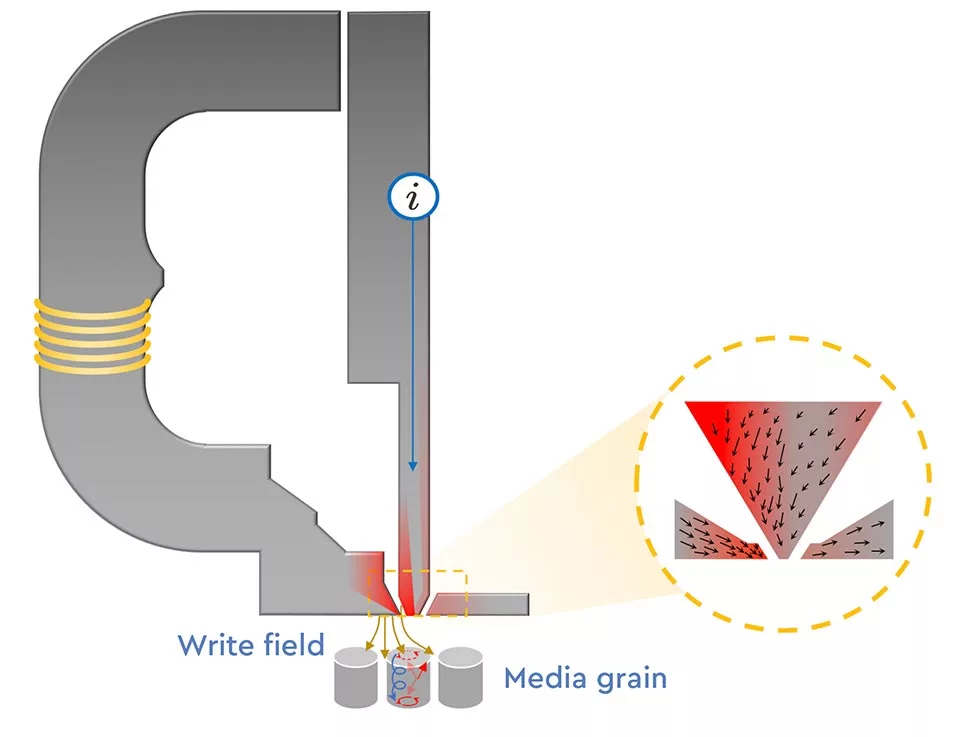
Recording head. Red = relative field from ePMR current - Image Credit: Disclosure
Advantages of ePMR Technology
ePMR brings several benefits. Let's list them clearly:
- More Storage Capacity: It allows for HDDs with more space. This is essential today. Data grows every day. From high-resolution photos to enterprise databases. ePMR offers more without increasing disk size. For example, WD launched 16TB and 18TB models using ePMR. This helps in crowded data centers.
- Better Performance: The technology improves speed. Bits become more stable. Recording and reading are more efficient. This is fundamental in IT. Think of servers that need fast access to large files. With ePMR, delays decrease. Tests show gains of up to 20% in speed in some scenarios.
- Less Energy Consumption: Efficiency is crucial. ePMR optimizes processes. This reduces electricity usage. Costs fall. Environmental impact improves. Data centers love this. They seek to reduce carbon emissions. An HDD with ePMR can save energy in 24/7 operations.
- Greater Reliability: Compared to older technologies, ePMR is more secure. It uses advanced error correction. Data is protected from failures. This reduces losses. In critical environments, such as hospitals or finance, reliability is everything.
In addition, ePMR integrates well with other innovations, such as SMR (Shingled Magnetic Recording). Together, they drive even greater capabilities.
Applications of ePMR Technology
ePMR applies to many sectors. Here are some key examples:
- Enterprise Storage: Companies with massive data volumes benefit. Cloud providers, banks, and telecoms use ePMR HDDs. They need secure and efficient storage. Sensitive data is protected. Scalability is easy without extra hardware.
- Entertainment and Media: 4K or 8K video production requires space. Studios and streaming services use ePMR. It handles huge files. Editing and storage become faster. Think of Netflix or YouTube: they manage petabytes of content.
- Artificial Intelligence and Big Data: AI needs vast amounts of data to train models. ePMR supports this on servers. Real-time analytics improve. Tech companies like Google or Amazon adopt such technologies.
- Personal and Home Use: For ordinary users, ePMR HDDs mean more space on PCs or NAS. Backing up photos, games, and movies becomes simple. Prices fall over time, making it affordable.
Impact on the Future of Storage
Looking ahead, ePMR could be a game-changer. With data exploding – thanks to IoT, 5G, and the cloud – we need scalable solutions. ePMR extends the life of HDDs. They compete with SSDs in cost per GB.
But there are challenges. Heat management is one. Research continues in search of better cooling. Integration with MAMR (Microwave-Assisted Magnetic Recording) may come soon.
Overall, ePMR balances performance and reliability. It requires precise engineering. Current, heat, and stability interact in a complex way.
Conclusion
ePMR is a big step in magnetic recording. It expands capabilities without sacrificing speed or security. Despite the thermal challenges, the potential is enormous. For businesses and users, it means more data with less effort. WD leads this, but others may follow. In the future, storage will be more accessible and efficient thanks to innovations like this.
* updated on 08/01/2026